
Caribbean Classics - Claiming Our Space At The Top
Our Stories Are Never on The Margins.
Classic literature can teach us so much about the past and what our ancestors hoped for our future. But the literary canon most associated with the term “Classic Literature” tends to be dominated by white, European & American men and about the world through their eyes.
In recent years, attempts to claim a more diverse idea “Classic Literature” still falls short due to the failure to examine the cultural imperialism in published literary works. Diverse Classic Literature lists still look very American and European, (if you’re lucky you may find Gabriel Garcia Marquez or Chinua Achebe in the mix)
Now don’t get us wrong, we have nothing against Charles Dickens and Jane Austen, or even Zora Neale Hurston, or James Baldwin. Read everything, read widely and critically.
But it’s a shame to not have Caribbean storytellers, be associated with many of the Classics.
In true Rebel Women Lit style, we’ve gotten tired of waiting on the world to catch up to the amazing literature produced in the Caribbean in the last century.
We’re celebrating Caribbean Classic Literature this September - December 2020 with the launch of our Caribbean Classics Subscription, with pre-loved & second-hand books from across the region published in the 1920s-1999.
Starting at $11USD wanted to make this subscription significantly lower than other subscription products because we want to get these books onto as many bookshelves of modern readers.
We hope to (re)introduce modern readers to the world of Caribbean Classic Literature, because as Shivanee Robinson says “Reading Caribbean Means Reading The World”.

Chat with Chaya Bhuvaneswar, author of White Dancing Elephants
Chat with Chaya Bhuvaneswar, author of the spectacular short story collection White Dancing Elephants. We talk about being both a psychiatrist and writer, her favourite stories, tv shows she’s binging, and women she wishes were single.
White Dancing Elephants is a radical, painful, and poetic short story collections that challenges our personal ideas of survival, power, and love in a postcolonial world where these stories would normally be erased. We picked up this collection for November 2019 and Chaya was kind enough to do a quick chat with us, in between working on her new essay collection.
We talk about her being a psychiatrist and writer, her favourite stories, tv shows she’s binging, and women she wishes were single.

Chaya Bhuvaneswar next to the cover page of her debut short story collection “White Dancing Elephants”
A woman in her forties drifts through London in denial about her miscarriage, a woman has an affair with her dying best-friend’s husband, a young boy escapes into folktales to avoid his grief over a lost sister and an abusive father…
these stories are all so complex and beautiful!
Thank you so much for writing and sharing this collection with us. What inspired you to write it?
Thank you!! more than words can say dear sisters for selecting my book. Hope so much you enjoy it? All the stories are completely honest, yet reflect my emerging craft, and writing that surprises me sometimes.
As much as I have loved the hundreds of short stories I've read in my life, I've never seen any facet of my experience - as South Indian origin, born in the US, queer, and selectively out, religious though not dogmatic or exclusionary - none of this complexity reflected in stories that purported to be about "Indian women" (as written by authors who were not Indian) or in stories by groundbreaking writers, like Bharati Mukherjee for example, who captured the rebellions but not the religious faith I also held.
A lot of our readers are working on their writing and are looking for advice in that process. Many don’t know that you’re not only an amazing writer, you’re also a psychiatrist! How has your career in medicine influenced your writing, both in content and in habits?
I think it does make you more forgiving of yourself, more willing to 'see where something goes' and just start putting words down on the page, if you have a really demanding day job and/or a family to raise, or some other set of tasks and work that you really have to do, likely because of what someone else needs from you very much. Once you are blessed with that sense of being needed, a lot of neurosis about writing and revising really does go away and you just figure out how to do it, even if you go slower at times than maybe you would if you were home all day. But the reality for me is that if I were home all day I would also likely waste a lot of time! So I am very grateful to be grounded in a day job that demands my full attention for many hours of the day.
There are small elephant icons that appear throughout the anthology, what does it and the title “White Dancing Elephants” symbolize?
Elephants symbolize Ganesha, the god of auspicious beginnings, as well as fertility, peace, strength more generally.
🐘
I think my favourite story is probably Talinda, it is such an interesting story about friendships between women, tell us more about what inspired this story of love, betrayal, bullying, and the complex tensions that inspired this.
An early friendship with a Talinda-like girl in 2nd grade definitely inspired this but then the characters really did lead the story far from anything I've experienced.
Another intense story is A Shaker Chair that dealt with sexual harassment, racism, and boundaries. What inspired such perplexing story?
I will confess I was angry and disappointed with someone similar in some respects to the Sylvia character and I 'wrote myself into' Maya's perspective - basically similar to my perspective on many things when I was a teenager - and imagined what it would be like if these two women tried to connect but basically were adults acting out teenage impulses and trauma.
Do you have a favourite story from the collection? As a writer do you get to pick favs?
I don't have a favorite story, actually, but the title, WHITE DANCING ELEPHANTS, that story, is dedicated in my heart to the child I lost when I had a miscarriage. For its closeness to that lost child I hold that story very close.
🐘
If White Dancing Elephants had a playlist, what would be on it?
White Dancing Elephants
"Ever So Lonely," by Sheila Chandra
The Story of the Woman Who Fell in Love with Death
"Learning to Fly" by Tom Petty
Talinda
"She’s Got Bette Davis Eyes" by Kim Carnes
We did come up with a playlist! and I was thrilled that it was published here: http://www.largeheartedboy.com/blog/archive/2018/10/chaya_bhuvanesw.html
Also parenthetically I am grateful to have connected with Largehearted Boy since they included WHITE DANCING ELEPHANTS on their "best story collections of 2018" list!
🐘
Quick Picks
Which woman or queer person is inspiring you right now?
Megan Rapinoe. I know she's not single but…
What are you currently reading?
Abandon Me, by Native American memoirist and essayist Melissa Febos. She's not single either *sigh *
What are you currently watching?
Unfortunately I'm going back to Billions, my standby, but before that I really liked The Affair. Go Showtime!
Physical, eBook or audiobook?
Physical book and audiobook for sure!
Who’s your favourite literary character?
Fleur from Tracks, by Louise Erdrich. Her guts and ability for magic. Her mother-love for her baby she tried everything to save.
What’s the last amazing book you read?
So many. I really enjoyed reading a book in manuscript by Marie Myung-Ok Lee. I also read (in galley) the most beautiful collection of stories and one you should pick for your club coming up If I Had Two Wings, by Randall Kenan Just gorgeous!
Follow Chaya Bhuvaneswar on Twitter and if you still haven’t read White Dancing Elephants, what are you waiting for? Go check it out!
Conversation with Nicole Dennis-Benn
We don’t think Nicole Dennis-Benn will ever write a book that is uncomplicated; nor should we ever want her to. We had the privilege to talk to her about her sophomore novel PATSY, language and self-care.
We don’t think Nicole Dennis-Benn will ever write a book that is uncomplicated; nor should we ever want her to. In her latest book PATSY, Nicole explores the complexities of motherhood, immigration, blackness, sexuality, class, religion, and mental health, in a story that weaves between mother & daughter.

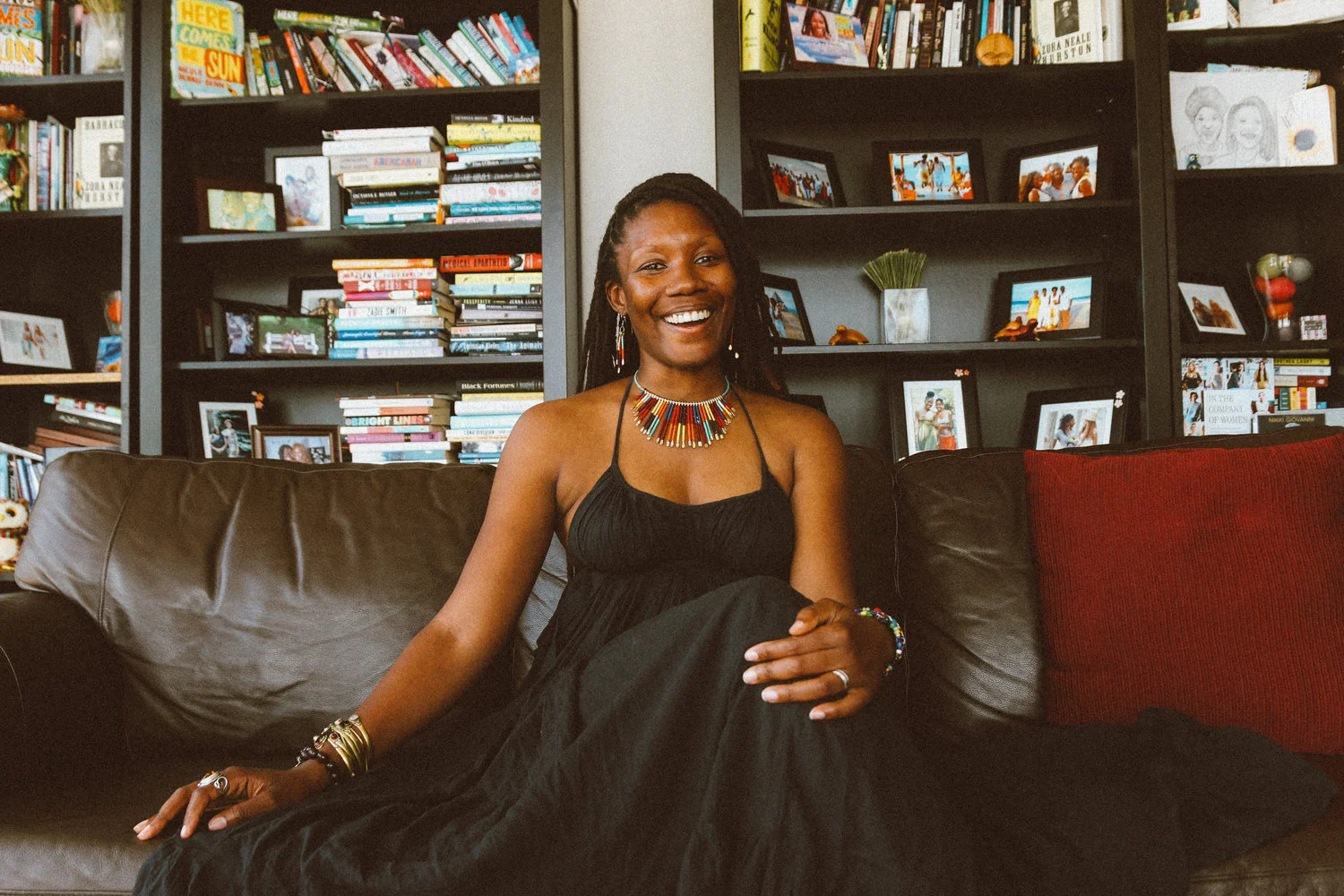
Photo of Nicole Dennis-Benn by Bashy Magazine
There’s been well-deserved praise for PATSY since the book came out a few months ago. What’s been your favorite response to the book so far?
My favorite response so far has been the messages I get from people, in particular women who have said they, too, weren’t in the emotional space for motherhood but had no one to confess this to; and people- men and women- saying they went through what Tru went through, growing up without their mother and questioning her abandonment. Because in society, we’re so used to fathers leaving or slacking, but not mothers. Mothers aren’t given that grace fathers get. So when those readers tell me that PATSY has helped them not only to voice their feelings about parenthood, but to understand where their mothers were probably coming from, and has helped them to reconcile with her truths, it warms my heart.
On the surface, PATSY is largely promoted as a novel on immigration, but when you read it you understand that the story is about so much more.
PATSY is definitely more than an immigrant narrative. However, it’s the nature of marketing to put books in categories that would get people to buy it. However, once they do buy and open any of my books, it becomes a Pandora’s box. When I sat down to write Patsy, yes, the first thing that came out was her constant awe of her new life in America. But the more I got to know her as a character, the more I realize that her story is a complex and extremely complicated one. Unlike any other immigrant narrative, Patsy’s reason for leaving is not an altruistic one. She’s leaving for what would be considered “selfish” reasons: she’s leaving to rekindle her relationship with her childhood best friend, Cicely; she’s leaving with hopes of having better opportunities; and deep down, she’s leaving to escape the role of motherhood. The question I posed and sought to answer in this book for myself is “what do we lose (or gain) when we choose ourselves?” This question becomes more poignant as a black woman given that we’ve always been considered as mothers and caretakers. I wanted to write the working-class black woman who dares to defy all that. I left it up to Patsy and Tru to define themselves in a world eager to define them. I also tap into mental health, in particular, depression and postpartum depression- another narrative that gets left out in the discussion of my book on a larger scale.
PATSY, just like your debut, stays true to Jamaican patois in conversations, and Ms. Lou would probably be proud.
“If I’m committed to writing my people on the page, then there’s no way I could do so without our language. ”
I was told growing up to never speak patois in public. It was something to be ashamed of, especially at school where teachers would punish us for it. I never knew then how unfair this was- to tell people that we couldn’t speak our own language. In high school I simply acquiesced to the culture of speaking only the “Queens English”. I was so good at it that my classmates thought I was uptown and never would’ve guessed I lived in Vineyard Town. And in Vineyard Town, I was somewhat odd with my speech as I grew sloppy at code switching. I wore the mask for so long that I didn’t realize that I swallowed my identity. It wasn’t until I became a writer that I began to reclaim the language I could no longer speak, though I think in patois, dream in patois, and write patois. At one point I became furious that it was stolen from me. Language is identity and for a long time I existed with a void. It became important for me to write it down in order to never forget it. It was also impossible to not write patois spoken between my Jamaican characters. It’s who we are. If I’m committed to writing my people on the page, then there’s no way I could do so without our language. My advice to young writers is to stay true to yourself and to your characters. The world will catch up.
A must-have playlist capturing the essence of Nicole Dennis-Benn's novel, PATSY (Norton/Liveright 2019).
Which songs would be on a PATSY playlist?
Life We Living by Vybz Kartel
Untold Stories by Buju Banton
Wrong Address by Etana
Black Hypocrisy by Spice
***I actually have a whole PATSY playlist with a lot more songs on my website!
It’s rare to find Jamaican novels that have gender non-conforming characters. What was your inspiration for Tru and how did you go about your research?
I really wanted to capture the narrative of the child left behind. For Tru, I wanted to increase the stakes with another complicated subplot- her inability to conform to her mother’s expectations of her. The last thing Patsy said to Tru before she left was “Be a good, obedient girl and I’ll be back for you.” This promise is not only a lie, but a trap. Imagine being told this at a young age, believing that if you’re not that “good, obedient girl” then your mother won’t come back. I took it farther by having Tru grow into something completely different, harboring both resentment and guilt.
The research for Tru was straightforward. I spoke to acquaintances who felt the way Tru felt in school - having to wear a uniform that didn’t quite represent their gender identity. Of course, we didn’t have the language “gender non conforming” then as teenagers; and I certainly didn’t put that language in the book since Tru doesn’t have the language for it either.
You write ‘place’ so well, Brooklyn and Kingston are so different yet similar and you managed to capture their nuances so well. How did you go about capturing the rhythm of each city?
Brooklyn happens to be my current home; but Kingston was my home before that, and continues to be an important place where I go to visit family and friends and memories. So capturing them on the page was the easy part.
You’ve mentioned many times the influence Toni Morrison has had on your writing and your introduction to literature, how do you feel about her passing?
“Toni successfully passed the torch to us, the next generation of black women writers.”
Toni Morrison brought me to literature. Before her, I had no knowledge of black writers, much less black female writers. In high school the only writer of color and of Caribbean decent I was taught was VS Naipaul. Toni Morrison’s work meant a lot in my development as a writer. When she passed, I felt grief. But it quickly dissipated the moment I realized that she left a good legacy behind. Toni successfully passed the torch to us, the next generation of black women writers.
Speed Round
Which woman or queer person is currently inspiring you right now?
Jacqueline Woodson
Currently reading?
Why Be Happy When You Could Be Normal by Jeanette Winterson
Physical book, ebook, or audiobook?
Physical book
Favourite literary character?
Sula
The last amazing book you read?
Heavy by Kiese Laymon